
Key Takeaway
The choice between an SUV and a Sedan in Winnipeg depends on your specific needs for ground clearance versus ongoing costs.
- Ground Clearance: SUVs typically offer 7-9 inches compared to 5-6 inches for sedans.
- Safety: Winter tires reduce stopping distances by over 5 meters, often outweighing AWD benefits alone.
- Cost: Sedans generally offer better fuel economy and lower insurance premiums.
- Resale: SUVs retain higher residual value in the Manitoba market.
Read on to discover which body style aligns best with your budget and lifestyle.
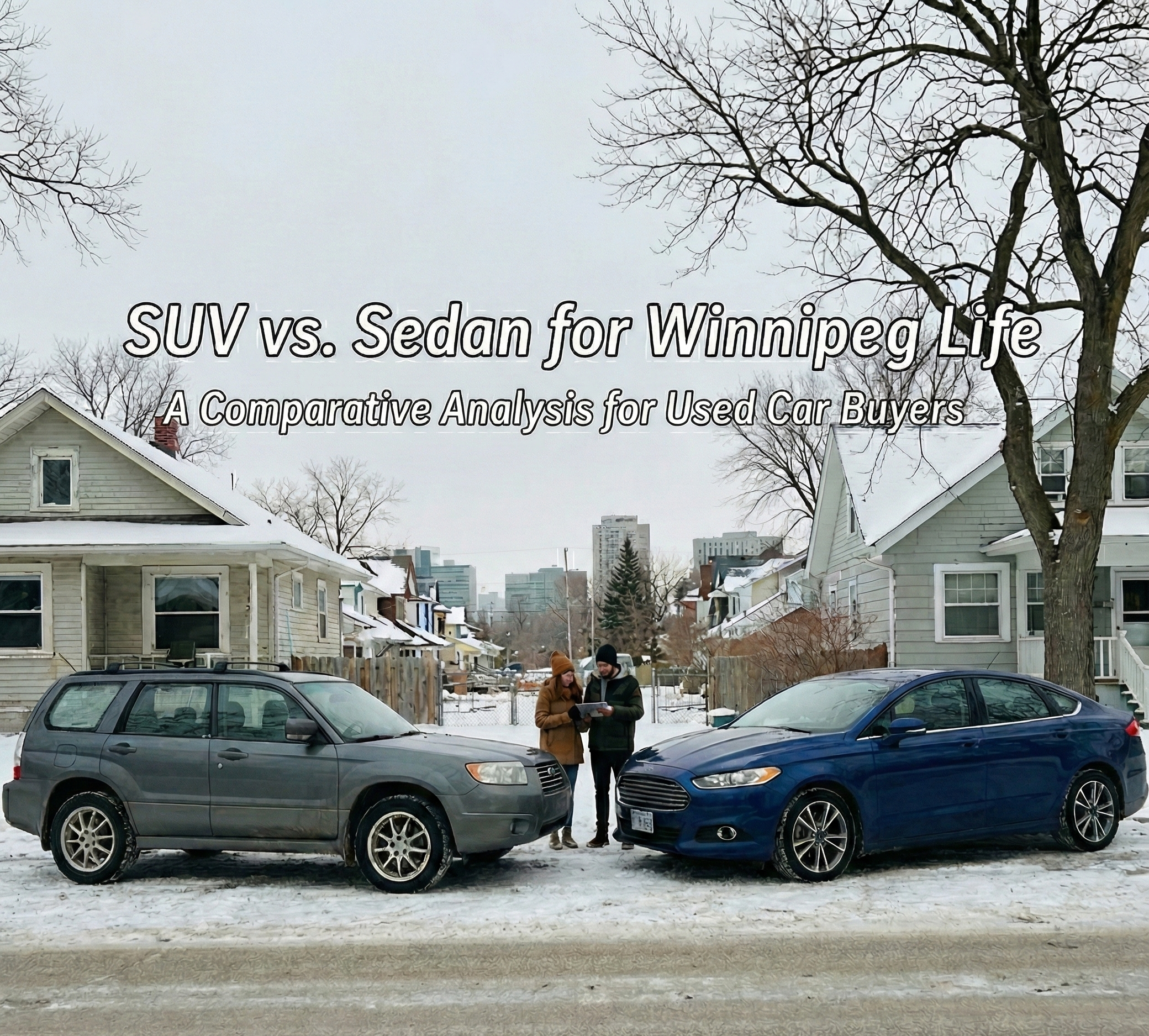
For most Winnipeg drivers, the choice between an SUV and a Sedan comes down to a specific trade-off: ground clearance and cargo versatility versus fuel economy and lower ownership costs. While SUVs offer superior capability for navigating deep snow ruts and hauling hockey gear, sedans generally provide better gas mileage and lower purchase prices, making them a savvy choice for urban commuters who invest in high-quality winter tires.
What Defines Winnipeg’s Unique Driving Landscape?
Winnipeg’s driving environment is defined by extreme weather conditions that demand vehicle resilience against -30°C temperatures and severe potholes. From the icy winds sweeping across the Perimeter Highway to the crater-like potholes that emerge on Portage Avenue during the spring thaw, your vehicle needs to be tough.
Choosing a used car here requires looking beyond the sticker price. You must consider how the vehicle handles cold starts, negotiates unplowed residential streets, and impacts your budget. This analysis cuts through the marketing noise to help you decide which body style truly suits your Manitoba lifestyle.
Which Is Better for Winnipeg: SUV or Sedan?
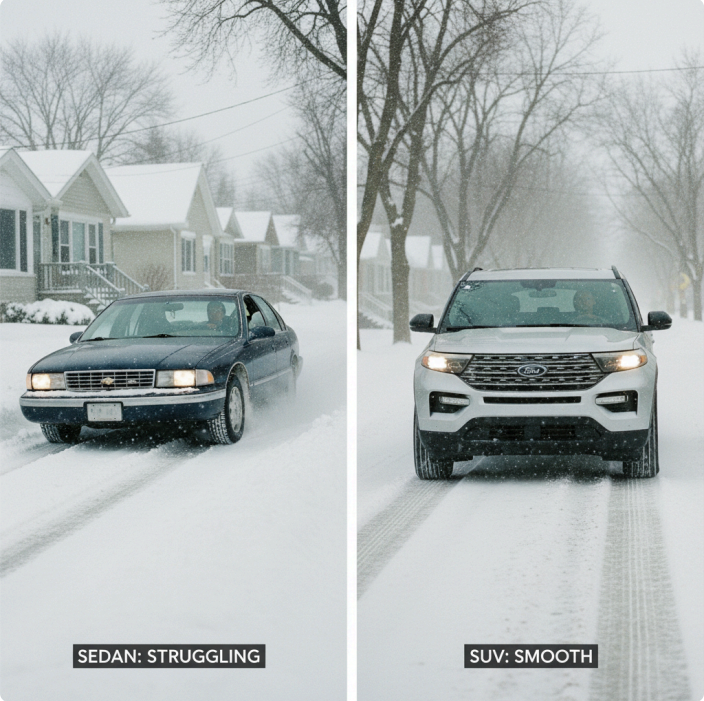
The Used SUV is typically the superior choice for drivers who navigate uncleared back lanes or transport families, while the Used Sedan is better for commuters prioritizing fuel savings. If your daily life involves driving outside the Perimeter Highway or transporting sports equipment, the extra ground clearance of an SUV is invaluable. However, if you primarily commute on cleared major routes like Route 90 and prioritize saving money, a sedan equipped with premium studded winter tires is a capable and financially prudent option.
What Are the Critical Factors for Manitoba Buyers?
Three “Make or Break” factors usually determine the right choice: ground clearance, tire quality, and the “SUV premium” on price. Before diving into technical details, keep these factors in mind when browsing used listings:
- Clearance is King: In February, the difference between 5 inches (sedan) and 8 inches (SUV) of ground clearance determines if you get stuck in your own driveway.
- Tires Trumps Drivetrain: A Front-Wheel Drive (FWD) sedan with top-tier winter tires will typically stop and corner better than an All-Wheel Drive (SUV) with all-seasons.
- The “SUV Premium”: Expect to pay 15-20% more for a used SUV compared to a sedan of similar year and mileage due to high local demand.
How Do Winter Performance and Safety Compare?
Winter performance depends more on traction and tires than vehicle size, though SUVs offer physical advantages in deep snow. While many buyers gravitate toward larger vehicles for safety, bigger isn’t always safer if the fundamentals aren’t there.
Ground Clearance vs. Winnipeg Snowbanks and Ruts
The most significant advantage an SUV holds over a sedan in Winnipeg is ground clearance. After a heavy snowfall, residential streets often develop deep ruts that freeze solid. Sedans run the risk of bottoming out, which can damage the undercarriage or leave the vehicle “high-centered” and stranded.
SUVs generally offer 7 to 9 inches of clearance, allowing you to straddle ice ridges that would scrape the bottom of a Honda Civic. For deep snow capability, you might look at external perspectives on Why Buying an SUV is the Right Choice for Manitobans to understand the mechanical advantages of ride height.
The Traction Debate: AWD SUVs vs. FWD Sedans with Winter Tires
While AWD helps with acceleration, dedicated winter tires are crucial for stopping and turning. Testing by Transport Canada demonstrated that winter tires could reduce stopping distance by over 5 meters compared to all-season tires in winter conditions.
A common mistake is buying an SUV with AWD and leaving all-season tires on it. For a deep dive on this, check our winter car maintenance tips. The reality is that a lighter sedan with dedicated winter tires often has shorter braking distances on ice than a heavy SUV. However, an SUV with AWD and winter tires offers the ultimate traction package.
Visibility and Handling on Icy Perimeter Highways
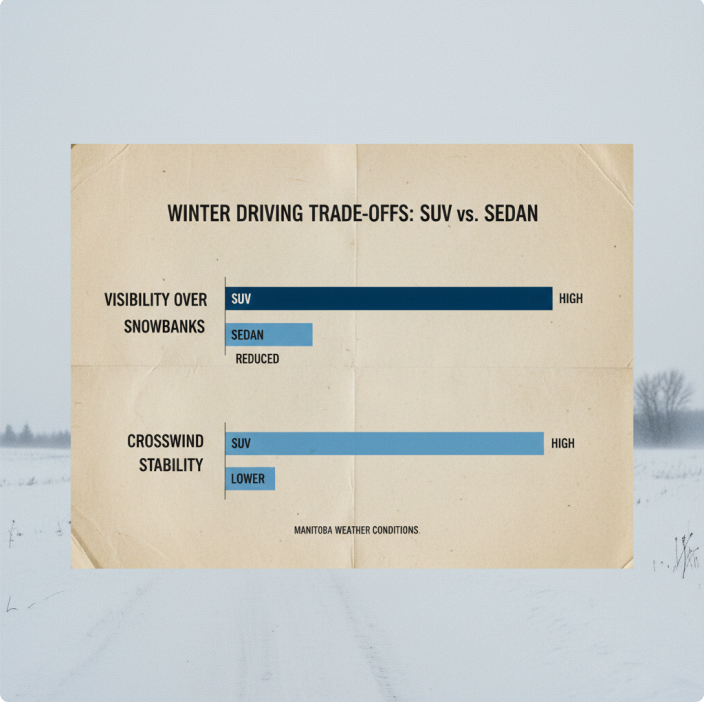
Sitting higher in an SUV improves visibility over snowbanks, but sedans often handle high crosswinds better due to a lower center of gravity. Data from the IIHS confirms that modern SUVs have the lowest driver death rate of any vehicle category, outperforming sedans in multi-vehicle crashes. This safety advantage, combined with better visibility, makes SUVs a strong contender for highway driving during whiteout conditions.
What Is the Financial Reality of Ownership?
Ownership costs in Winnipeg are heavily influenced by fuel consumption during cold snaps and insurance premiums, where sedans typically have the advantage. Buying the car is just the entry fee; keeping it running is where the real costs lie.
Fuel Efficiency Realities During -30°C Cold Snaps
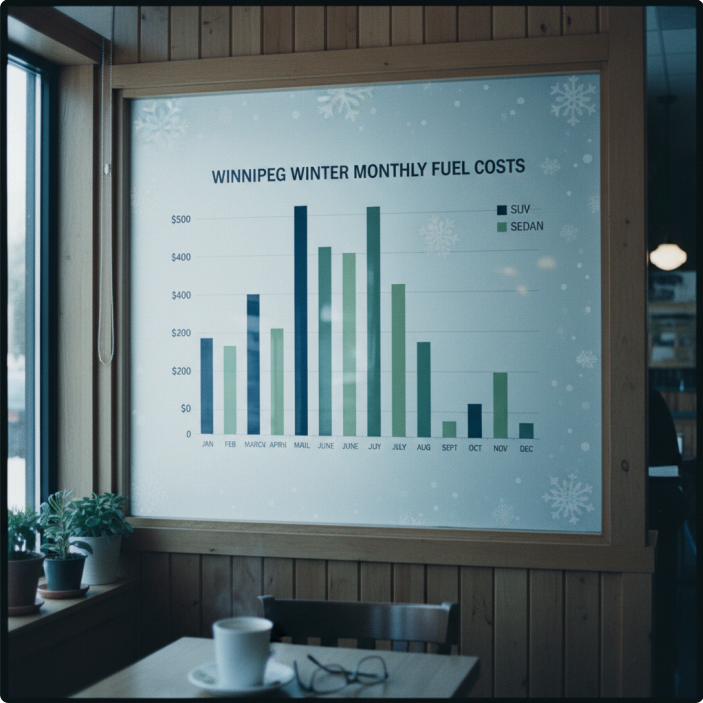
Extreme cold significantly impacts fuel economy, particularly for heavier vehicles like SUVs. According to Natural Resources Canada, a temperature drop from 24°C to 7°C increases city fuel consumption by 12% to 28%, with potentially higher increases in colder conditions.
If you drive a V6 SUV, your fuel bill will likely be higher than a 4-cylinder sedan during January and February. For those looking to manage these costs, we offer options for used car financing in Winnipeg that can help budget for efficient vehicles.
MPI Insurance Rates: Comparing Premiums for Used SUVs and Sedans
Manitoba Public Insurance (MPI) rates are generally lower for used sedans because they are less expensive to replace. Rates are based on claim history and vehicle value. However, some popular sedans with high theft rates may have surcharges. It is vital to calculate the total cost of ownership, not just the monthly payment. Read more about The True Cost Of Used Car Ownership In Winnipeg Beyond The Sticker Price to budget correctly.
The ‘Pothole Tax’: Suspension Repair Costs and Durability
Winnipeg’s potholes can take a toll on any vehicle, but SUVs often have more robust suspension components. This design can lead to fewer alignments and strut replacements compared to more fragile sedans. However, when SUV tires need replacing, they are significantly more expensive due to larger rim sizes and more rubber.
Which Offers Better Practicality and Lifestyle?
The best vehicle choice depends on your specific daily routine, with sedans favoring urban agility and SUVs favoring cargo capacity.
Urban Agility: Parking in Downtown Winnipeg and The Exchange
If you work downtown or frequent the Exchange District, the compact footprint of a sedan is a massive benefit. Squeezing into tight parallel parking spots or navigating narrow parkades is far less stressful in a compact car than a full-size SUV.
Cargo Capacity: From Costco Runs to Hockey Gear
This is the SUV’s home turf. The vertical cargo space allows for bulky items like hockey bags, snow blowers, or Costco hauls that simply won’t fit in a sedan’s trunk. Hatchback access is also generally easier for loading groceries in the cold than reaching into a deep trunk.
Ride Comfort: Absorbing the Spring Thaw Bumps
Longer suspension travel in SUVs usually translates to a smoother ride over broken pavement. If your daily commute involves road construction zones, the extra cushioning of an SUV can reduce driver fatigue.
How Do SUVs and Sedans Compare Head-to-Head?
Below is a comparison of average metrics for 5-year-old used vehicles common in Manitoba to help you visualize the differences.
| Feature | Mid-Size Sedan (e.g., Camry/Accord) | Compact SUV (e.g., RAV4/CR-V) | Winner for Winnipeg |
|---|---|---|---|
| Ground Clearance | 5.5 – 6.0 Inches | 7.5 – 8.5 Inches | SUV |
| Fuel Economy (Winter) | 10 – 12 L/100km | 13 – 16 L/100km | Sedan |
| Tire Cost (Set of 4) | $800 – $1,000 | $1,100 – $1,400 | Sedan |
| AWD Availability | Rare (mostly FWD) | Standard or Common | SUV |
| Cargo Volume | 15 – 17 cu. ft. (Trunk) | 35 – 70 cu. ft. (Seats down) | SUV |
| Best For | Commuting & Economy | Family & Deep Snow | – |
What Are the Top Used Picks for Winnipeg Buyers?
Reliability and heating performance are the top traits to look for in used vehicles for Manitoba. Knowing the pros and cons, specific models stand out.
Best Used SUVs for Deep Snow and Family Safety
Look for models with proven AWD systems and high reliability scores. The Toyota RAV4, Honda CR-V, and Ford Escape are staples here. If you are looking to upgrade, you might consider checking your current vehicle trade-in value before purchasing. For a broader look at market availability, check out Used SUV in Winnipeg guides or browse our own inventory.
Budget-conscious buyers should also look at older reliable models. There are great resources on finding 5 of the Best Winter Cars & SUVs For Bargain Hunters to get you started.
Best Used Sedans for Fuel Economy and Value
If you choose the sedan route, reliability is key. The Honda Civic, Toyota Corolla, and Mazda3 are excellent choices. They heat up quickly, sip fuel, and are easy to maintain. A well-maintained Chevrolet Impala is also a local favorite for its heavy weight and ability to plow through drifts surprisingly well.
What Should Be on Your Manitoba Inspection Checklist?
Every used car in Manitoba must be inspected for salt corrosion and battery health regardless of body style.
Rust and Corrosion: The Salt Reality
Manitoba uses salt and sand on roads, which accelerates rust. Inspect the rocker panels, wheel wells, and the bottom of the doors. If you see bubbling paint, the rust is likely deeper than it looks. For a complete guide on what to look for, read The Ultimate Canadian Used Car Buyer’s Checklist: Navigating Manitoba Regulations.
Block Heater and Battery Cold-Cranking Amps
Ensure the block heater cord is intact and working. Furthermore, check the battery date code. In Winnipeg, a battery older than 4 years is a liability. You need high Cold Cranking Amps (CCA) to turn the engine over at -35°C.
How Do Resale Value and Depreciation Trends Compare?
SUVs typically hold their value better in the Manitoba market due to the constant demand for AWD vehicles. If you buy a used SUV today, you will likely recoup a larger percentage of your money when you sell it in 3 years compared to a sedan.
However, sedans depreciate faster initially, making them a better buy on the used market if you plan to keep the car long-term. If you are worried about credit scores affecting your purchase, our guide to bad credit car loans can help navigate financing options for both SUVs and Sedans.
How Do You Match the Vehicle to Your Life?
The “best” car is simply the one that fits your specific daily routine and budget. If you value peace of mind during blizzards and carry lots of gear, the extra cost of an SUV is justified. If you want to keep your overhead low and stick to city streets, a Sedan is a smart, economical winner.
Don’t just read about the differences, feel them. The best way to decide is to get behind the wheel. We invite you to Test Drive a Vehicle in Winnipeg today and see which one feels right for you.
Frequently Asked Questions
Which is safer for Winnipeg winters, an SUV or a Sedan?
It depends on the tires. While SUVs often feature AWD which helps with acceleration, a sedan equipped with high-quality winter tires will typically stop and turn better than an SUV with all-season tires. However, an SUV with both AWD and winter tires offers the maximum safety advantage.
How much more does an SUV cost to run than a sedan?
Expect to pay 15-30% more. This includes higher fuel consumption (especially in winter), more expensive tires, and typically higher insurance premiums. Heavier SUVs consume significantly more fuel during cold starts and idling compared to lighter 4-cylinder sedans.
Do I really need an SUV for driving in Winnipeg?
Not necessarily. If you primarily drive on cleared major routes like Portage Avenue or Route 90, a sedan is perfectly adequate. An SUV is only essential if you regularly navigate unplowed back lanes, deep ruts, or require extra cargo space for family activities.
Why do SUVs hold their resale value better in Manitoba?
High demand for AWD. The perception that AWD is necessary for Manitoba winters keeps demand for used SUVs high. This means they depreciate slower than sedans, offering a better return when you eventually trade it in or sell it.
Last Updated: 26 January 2026
References
- Natural Resources Canada – Factors that affect fuel efficiency in cold weather.
- Transport Canada – Winter tire testing results and stopping distances.
- Insurance Institute for Highway Safety (IIHS) – Driver death rates by vehicle type.