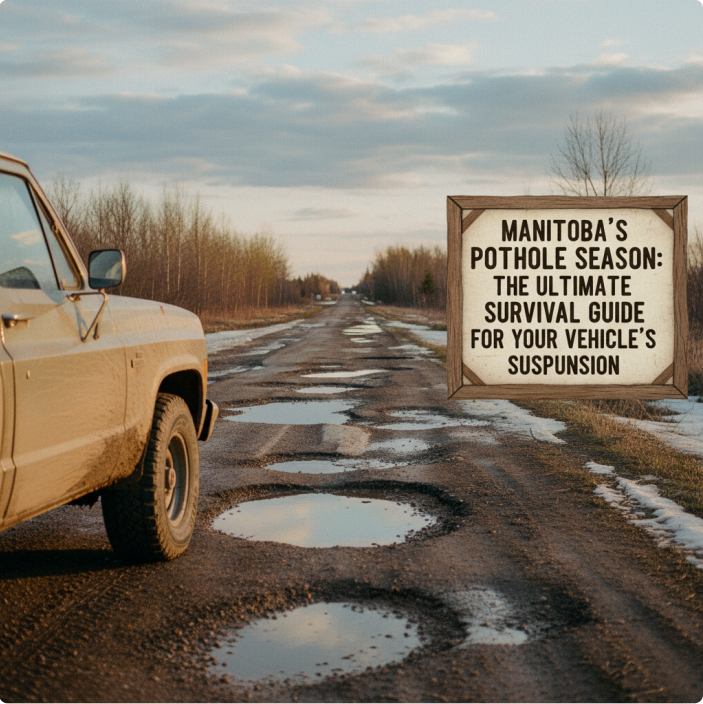
Manitoba pothole season is an inevitable annual event where freeze-thaw cycles create
hazardous driving conditions that can cause significant suspension damage. Yes, Manitoba Public Insurance (MPI) does cover pothole damage, categorizing it as a collision claim
subject to your deductible and potential Driver Safety Rating (DSR) impact. However, holding
the City of Winnipeg liable for reimbursement is much more difficult, requiring proof of
“gross negligence.” Surviving this season requires a mix of defensive driving, proper tire
maintenance, and knowing exactly how to inspect your vehicle for damage after an impact.
Navigating the Crater-Filled Roads of
Manitoba
As winter recedes and spring arrives in Manitoba, the snow melts to reveal a crumbling
infrastructure. Water seeps into cracks in the asphalt, freezes, expands, and breaks the
pavement apart, leaving behind deep craters. For Winnipeg drivers, navigating routes like
Portage Avenue, St. James, or Henderson Highway becomes an obstacle course.
The impact of hitting a deep pothole goes beyond the jarring physical sensation; it places
immense stress on your vehicle’s shocks, struts, control arms, and tires. Understanding the
financial and mechanical implications of these impacts is essential for keeping your vehicle
roadworthy and your wallet intact.
Does MPI Cover Pothole Damage? (The 30-
Second Summary)
If you hit a pothole and damage your vehicle, MPI will cover the repairs, but it is processed
as an at-fault collision claim. This means you must pay your deductible (typically $500 or
$750, depending on your policy). Furthermore, because it is considered a single-vehicle collision, it may negatively affect your placement on the Driver Safety Rating (DSR) scale,
potentially increasing your future premium costs.
Before filing a claim, you should always assess the cost of repairs against your deductible. If a
repair costs $400 and your deductible is $500, filing a claim is financially counterproductive.
MPI Coverage Basics: Collision Claims and Deductibles
When you open a claim with MPI for pothole damage, a localized estimator will assess the
vehicle. They look for fresh impact damage consistent with a road hazard. It is vital to note
that MPI generally does not cover wear and tear. If your struts were already leaking before
the pothole impact, coverage may be denied or limited to the parts that specifically broke
during the incident.
City of Winnipeg Liability: The ‘Gross Negligence’
Standard
Many drivers assume the City of Winnipeg pays for pothole damage automatically. This is a
myth. Under the City of Winnipeg Charter, the city is only liable if you can prove gross
negligence. This means you must prove the city knew about the specific pothole and failed
to repair it within a reasonable timeframe, or that the repair was performed negligently. This
is a high legal bar to clear, and most direct claims against the city are denied.
The Winnipeg Pothole Claim Protocol:
Step-by-Step Guide
If you have sustained significant damage that warrants a claim, following the correct protocol
is crucial for a successful outcome. Whether you are aiming for MPI coverage or attempting
the difficult path of City reimbursement, documentation is your best defense.
How to Report a Pothole to the City of Winnipeg (311
Process)
Before you even fix your car, you must report the pothole. This creates a paper trail proving
the city is aware of the hazard.
- Call 311 or use the online form on the City of Winnipeg website.
- Provide the exact location (e.g., “Northbound Kenaston, curb lane, 50 meters past the
McGillivray intersection”). - Request a reference number for your report.
Documenting the Scene: What Evidence You Need for
Reimbursement
If it is safe to do so, return to the scene to gather evidence.
- Photos: Take wide shots to show context and close-ups to show depth. Use an object (like a coin or ruler) for scale.
- Time and Date: Record the exact moment of impact.
- Witnesses: If passengers or bystanders saw the impact, get their contact info.
Filing Your Claim with Manitoba Public Insurance (MPI)
Once you have your evidence, contact MPI. Be honest about the incident. You will need your
license, registration, and the details of the location. Once you have a claim number, you can
schedule an estimate. If the vehicle is undrivable, arrange for a tow to a repair facility
immediately.
Signs of Suspension Damage After an
Impact
Not all damage is immediately catastrophic. Sometimes, a pothole impact starts a slow
degradation of suspension components that leads to failure weeks later. As experts in
Winnipeg, MB Vehicle Service & Repair – Hiru Auto, we recommend looking for specific
sensory cues immediately after a hard hit.
Audible Clues: Clunks, Rattles, and Bangs When Going
Over Bumps
If you hear a metallic “clunk” or “knock” when driving over uneven pavement or speed
bumps, you likely have damaged suspension bushings, a broken sway bar link, or a
compromised ball joint. A “rattle” often indicates loose components, while a loud “bang”
usually suggests a bottomed-out strut or broken spring.
Tactile Warnings: Steering Wheel Vibration and Alignment
Pull
Your hands on the steering wheel are your best diagnostic tool.
- Vibration: If the wheel shakes at highway speeds, you likely have a bent rim or a wheel weight has been knocked off, causing an imbalance.
- Pulling: If the car drifts to the left or right when the steering wheel is straight, the alignment has been knocked out of spec. This will destroy your tires rapidly if not corrected.
Visual Inspection: Bent Rims, Bubble Tires, and Leaking
Struts
Inspect your wheels and wheel wells.
- Tire Sidewall Bubbles: This indicates the internal structure of the tire has failed. It is a ticking time bomb and must be replaced immediately.
- Bent Rims: Look for flat spots on the lip of the wheel.
- Leaking Struts: Look for oil dripping down the shock absorber.
Decoding Your Dashboard Warning Lights
A severe pothole impact can sometimes jar sensors loose or damage wheel speed sensors,
triggering lights on your dash. If you see the ABS, Traction Control, or Tire Pressure light
illuminate after a hit, do not ignore it. For a deeper understanding of what these symbols
mean, read our guide on Decoding Your Dashboard A Winnipeg Drivers Guide To
Common Warning Lights And What They Mean to determine the urgency of the issue.
Estimated Pothole Repair Costs in Winnipeg
Understanding the financial risk helps drivers make better decisions regarding deductibles
and repairs. Below are average estimated costs for common pothole-related repairs in the
Winnipeg market. Note that costs vary based on vehicle make and model (luxury and
European vehicles will be higher).
Average Repair Costs (Alignment vs. Control Arms vs.
Struts)
| Component Damaged | Symptoms | Estimated Repair Cost (Parts & Labor) |
| Wheel Alignment | Vehicle pulls to one side; uneven tire wear | $120 – $180 |
| Tire Replacement | Sidewall bubble, blowout, rim leak | $150 – $400 per tire |
| Bent Steel Rim | Vibration, air loss | $100 – $150 |
| Bent Alloy Rim | Vibration, visible flat spot | $200 – $800+ (Repair vs. Replace) |
| Control Arm | Clunking noise, steering wander | $350 – $700 |
| Strut/Shock Absorber | Bouncing, leaking fluid, nose-dive braking | $600 – $1,200 (usually replaced in pairs) |
| Tie Rod End | Loose steering, clunking | $150 – $300 |
The Hidden Costs of Ignoring Minor Suspension Damage
Ignoring a slightly bent rim or a minor alignment issue is a false economy. A vehicle that is
out of alignment by just a fraction of an inch can wear out a set of $1,200 tires in less than a
season. Furthermore, worn suspension parts increase stopping distances, putting you at
higher risk of accidents.
When to Schedule Professional Service & Repair at Hiru
Auto
If you notice any of the symptoms listed above, or if your steering wheel is no longer
centered, it is time to bring your vehicle in. Early intervention can often save the tire or
prevent a loose part from failing completely. For more tips on keeping your vehicle running
smoothly in local conditions, browse our articles on Winnipeg Car Maintenance.
Prevention Strategies for Pothole Season
The best way to handle pothole damage is to avoid it entirely. While some craters are
unavoidable, changing your driving habits can significantly reduce the risk of impact.
Defensive Driving: Scanning for ‘Manitoba’s Worst Roads’
Experience teaches us which lanes to avoid. Stay alert and look well ahead of the hood of
your car. Keep in mind that puddles often hide the deepest holes. Recently, 18th Street in
Brandon was voted Manitoba’s worst road, but similar conditions exist throughout
Winnipeg. Treat unknown puddles as deep hazards.
Tire Maintenance: The Critical Role of Air Pressure and
Sidewall Height
Your tires are the first line of defense.
- Proper Inflation: Under-inflated tires compress too easily, allowing the pothole to smash the rim, bending it. Over-inflated tires are too stiff and transmit the shock to the suspension. Stick to the manufacturer’s recommended PSI found in the door jamb.
- Sidewall Height: Low-profile tires look great but offer very little cushion against impacts. They are much more susceptible to rim damage.
Why Following Distance Matters More in Spring
Tailgating is dangerous in any season, but in spring, it blinds you. If you are following too
closely, you cannot see the road surface ahead. By the time the car in front of you swerves or
hits the pothole, you have zero reaction time to avoid it. Increase your following distance to 3
or 4 seconds to give yourself time to scan the road surface.
Choosing the Best Car for Winnipeg
Potholes
If you are tired of bending rims on a sports sedan, it might be time to consider a vehicle
better suited for Manitoba’s topography.

Why Suspension Geometry and Tire Profile Matter
Vehicles with longer suspension travel (like SUVs and trucks) absorb impacts better than
sedans. Furthermore, vehicles equipped with high-profile tires (more rubber between the rim
and the road) offer a cushion that absorbs the energy of a pothole strike before it bends
metal.
Browse Our Inventory: Top Used SUVs and Trucks for
Rough Roads
If your current vehicle isn’t cutting it, consider upgrading to a crossover or truck with higher
ground clearance and robust suspension. Check out our inventory to see our current
selection of road-ready vehicles designed to handle the toughest Winnipeg commutes.
Car Financing Options for Vehicle Upgrades
Upgrading to a safer, more robust vehicle doesn’t have to break the bank. We offer flexible
Car Financing available in Winnipeg to help you get into a vehicle that can withstand the
spring thaw without constant repair bills.
Long-Term Maintenance and Safety
Implications
Pothole damage isn’t just an annoyance; it’s a safety issue that can cause your vehicle to fail
provincial inspections.
How Pothole Damage Affects Your Manitoba Safety
Inspection
When you buy or sell a used car, it must pass a safety inspection. Ball joints, tie rods, and strut
mounts, all common victims of potholes, are critical fail points. If there is play in these
components, the vehicle is deemed unsafe. To understand exactly what inspectors look for,
review The Ultimate Checklist What A Manitoba Safety Inspection Covers For Your Used
Car.
Routine Maintenance Checks to Prevent Catastrophic
Failure
Don’t wait for the annual safety inspection. Have your suspension checked during every oil
change, especially after spring. Identifying a loose tie rod end early costs a few hundred
dollars; waiting until it snaps on the Perimeter Highway can be catastrophic.
Protecting Your Wallet and Your Ride
During Thaw Season
Winnipeg’s pothole season is a formidable adversary for any vehicle owner. By understanding
MPI coverage, driving defensively, and recognizing the early signs of suspension damage, you
can mitigate the risks. Keep your tires inflated, keep your eyes on the road, and address those
“clunks” and “rattles” immediately to ensure your vehicle survives the thaw ready for summer
driving.